
India, Pakistan, Israel and South Sudan were the four UN member states which have not signed the NPT, the international pact aimed at preventing the spread of nuclear weapons.

Pak approaches NSG for a nuclear deal similar to the US-India one

Rhodes remarks on India came in response to a question about why some countries like China are opposing India's membership in the 48-member NSG.
Pakistan said that the incipient United States-India nuclear deal has spelled concerns in Islamabad over maintenance of strategic stability in the region, but that it will keep the balance despite its opposition to arms race.

'We were in a heavily nuclearised environment. China had tested for Pakistan in the 1980s and helped their missile programme stay just one step behind us.'
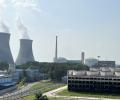
Government sources said amendments were being considered to the Atomic Energy Act to allow private sector participation and the Civil Liability for Nuclear Damage Act to limit the liability on suppliers of equipment to build atomic energy plants.

'Pakistan's is the only military-controlled nuclear weapons programme in the world.' 'As people get radicalised, the risk of a brigadier or pilot taking matters into their own hands is a real concern.'
The United States has said that it will vote against an exemption for China to sell two civil nuclear reactors to Pakistan at the Nuclear Suppliers Group meeting, in a new move to step up pressure to get the controversial deal annulled. Making it clear that the US will oppose the recent decision of China to sell two nuclear reactors to Pakistan, a top Barack Obama administration official told lawmakers that Washington will vote against the China-Pakistan deal.
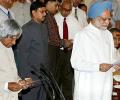
The landmark India-US civil nuclear deal of 2008, brokered during Manmohan Singh's tenure as Prime Minister, is seen as a crowning achievement in his foreign policy legacy. The agreement ended India's nuclear isolation, fostered a strategic partnership with the US, and opened doors to advanced technologies and defense cooperation. This historic deal also laid the groundwork for India's engagement with the global nuclear community.
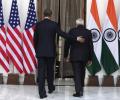
"Prudence and caution" needs to be exercised, warns China.
Forty domestic companies, including the Videocon group, Jindal Power and Tata Power, have formed a group to convince the central government to allow private participation in generation of civilian nuclear energy.
If the UPA government signs the nuclear deal with onerous conditions, its credibility will be undermined. If the deal collapses, the UPA stands to become the nation's laughing stock.
All this makes nonsense of the idea of India's professed "credible minimum deterrent", which is understood as a few dozen weapons. (After all, how many bombs does it take to flatten five Chinese or Pakistani cities? 15, 20, 50?) India already has an estimated 100 to 150 nuclear weapons. Adding to the stockpile can only encourage a vicious nuclear arms race with Pakistan and, more ominously, with China, further destabilising already volatile South Asia
The country is planning to increase its nuclear power generation by about 60,000 mega watts (Mw) within the next 25 years. This planned capacity addition is being executed by the state-owned Nuclear Power Corporation of India Ltd (NPCIL). Its head, Chairman and Managing Director SK Jain, tells P B Jayakumar about his plans and expectations.
China's assistance to build new nuclear plants in Pakistan are "inconsistent" with its commitments to Nuclear Suppliers Group, a top United States official has said.
The French move assumes significance as it comes close on the heels of conclusion of Indo-US civilian nuclear deal.
Pakistan, with some help from China, will demand its share in the changing nuclear order.
France on Thursday said it wanted to increase civil nuclear cooperation with India, but only after New Delhi implemented the legal framework. ''We want to move further, but first we need India to sign an agreement with the nuclear watchdog, International Atomic Energy Agency, and also to negotiate the exemption agreement with the Nuclear Suppliers' Group,'' visiting French Minister for Higher Education and Research Valerie Pecresse told a press conference in New Delhi.
Russia also welcomed the separation plan of military and civilian nuclear programmes and India's compliance with non-proliferation norms.
The two countries decided to set up a joint commission on military-technical cooperation during wide-ranging talks between Prime Minister Manmohan Singh and visiting Belarus President A G Lukashenko in New Delhi.
India on Monday signed a civil nuclear cooperation deal with South Korea, allowing a framework for Korean companies to participate in atomic power plant projects in the country.
Canada will become the latest country with which India shall have civil nuclear deal since the Nuclear Suppliers Group (NSG) allowed New Delhi to resume global nuclear trade in September 2008.
Notwithstanding the Nuclear Suppliers Group waiver for New Delhi, Japan on Wednesday appeared non-committal on civil nuclear cooperation with India even as the two countries agreed that atomic power could play an important role as a sustainable and non-polluting source of energy in meeting the growing global demands
Unruffled by global concerns, Beijing and Islamabad are in talks to build a new nuclear reactor in Pakistan of 1 gigawatt capacity, three times more powerful than existing ones, apparently without the approval of the International Atomic Energy Agency or the Nuclear Suppliers Group.
India was on Wednesday unperturbed by Nuclear Suppliers Group's decision to strengthen guidelines on enrichment and reprocessing technology transfer, saying it expected its bilateral agreements on full implementation of nuclear deals to be fully honoured without any pre-conditions.
In the final step to operationalise the India-United States nuclear agreement, American President George W Bush has sent the text of the landmark agreement to the US Congress for final approval.The move by the White House comes five days after the 45-member Nuclear Suppliers Group granted a waiver for India to carry out nuclear commerce.In a statement, the White House said it was transmitting the text of the agreement 'concerning peaceful uses of nuclear energy'.
'Romania fully understands and supports India's intention to expand its possibilities to generate civil nuclear power.'
It's highly unlikely that China will give up playing the Pakistan card vis-a-vis India anytime soon. Indian policy makers would be well advised to disabuse themselves of the notion of a Sino-Indian rapprochement. China doesn't do sentimentality in foreign policy, India should follow suit, writes Harsh V Pant.
The 123 agreement commits Washington to ensure uninterrupted supplies to India's safeguarded civilian nuclear reactors through engagement with other Nuclear Supplier Group countries.
Pakistan Atomic Energy Commission Chairman Perwaiz Butt said Pakistan was an energy-deficient country and needed nuclear power to meet its future electricity needs.
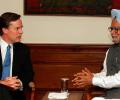
The India-US nuclear deal was aimed at ending India's nuclear isolation and nuclear apartheid, recalls Rup Narayan Das.
Protesting against the NSG waiver to India, Pakistan today blocked negotiations on Fissile Material Cut-off Treaty (FMCT), describing the move as "discriminatory" that will help New Delhi stockpile bomb- making nuclear materials.
India on Sunday sought South Korea's support in its bid for the membership of the Nuclear Suppliers Group and other international regimes related to nuclear trade.
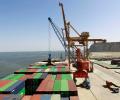
The customs officials, based on an intelligence input, halted a Malta-flagged merchant ship -- CMA CGM Attila -- at the port en route to Karachi on January 23 and inspected the consignment, which included a Computer Numerical Control (CNC) machine, originally manufactured by an Italian company.
Claiming that the Nuclear Suppliers Group had 'reneged' on its waiver on nuclear fuel supply to India, Bharatiya Janata Party on Tuesday accused Prime Minister Manmohan Singh of betraying the nation on the Indo-US nuke deal and asked him to clarify how it is beneficial to the country.
The US has sought more information from China on its agreement to supply two nuclear reactors to Pakistan, saying the deal would need an agreement of the Nuclear Suppliers Group. "We as a first step are looking for more information from China as to what it is potentially proposing," State Department spokesman P J Crowley told media-persons at his daily press briefing.

Prime Minister Manmohan Singh on Monday welcomed the US decision to lift controls on export of high technology items and technologies to India as well as its offer of support the country's membership in multilateral export control regimes like Nuclear Suppliers' Group.
The United States on Monday indicated that it is favourably inclined to the civilian nuclear deal between China and Pakistan, but it should be in compliance with the rules of Nuclear Suppliers Group.
As uncertainty over the fate of the civil nuclear deal continues, the United States has said the pact is likely to clear the hurdles at International Atomic Energy Agency and the Nuclear Suppliers' Group, but the 'main stumbling block' is the internal political process in India. "If the Indian government approves it, I do think that then what remains is to get an agreement with the IAEA and with the NSG. But I think those things are definitely feasible." John Negroponte said.
